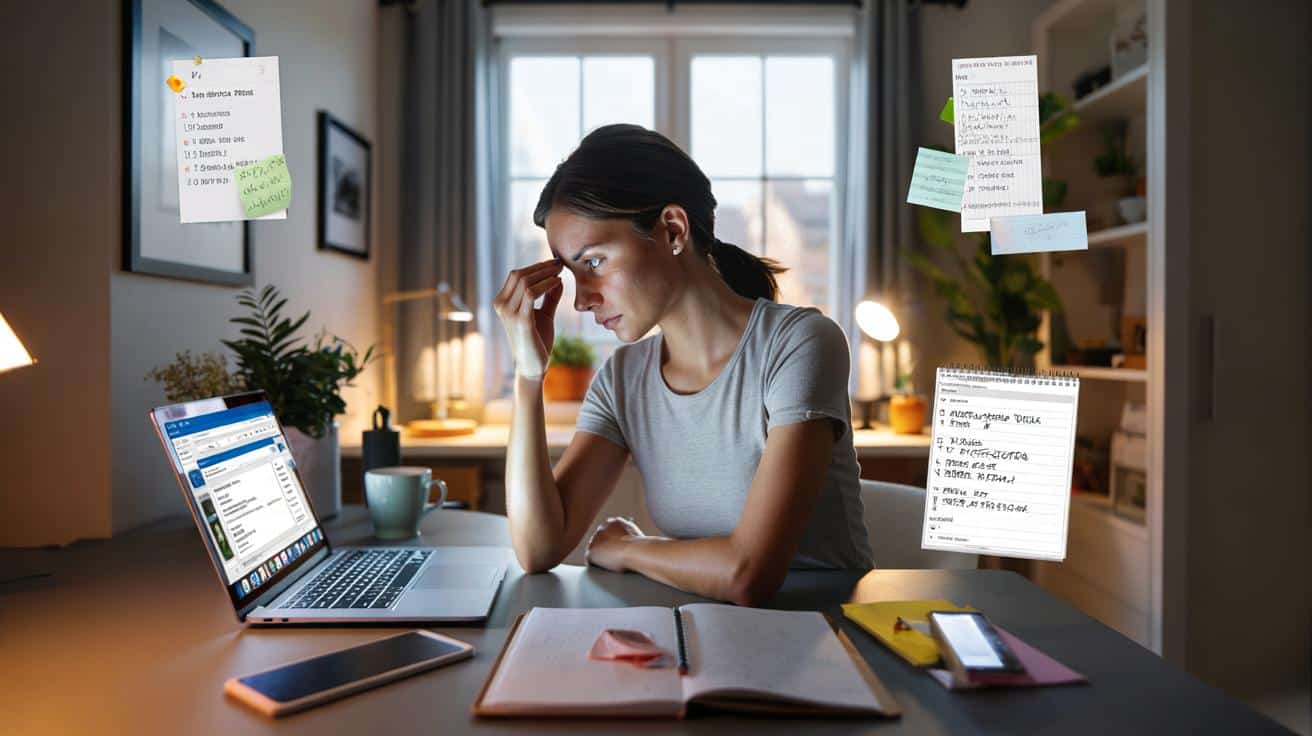
The house is quiet, notifications are muted, and nobody is arguing with you. Still, your brain feels like it has been blendered. You’ve ticked off your tasks, replied to the emails, maybe even squeezed in a workout. Yet by late afternoon, reading a simple message suddenly feels like solving advanced physics. You stare at your screen, re-reading the same line, as if your mind’s “loading” bar is stuck at 73%.
There’s no drama, no crisis, no visible stress. Just that dense fog behind your eyes, that strange mix of tired but wired.
You start wondering: how can your mind be this exhausted when your emotions feel… oddly flat?
When your brain is drained but your heart feels fine
Mental fatigue without big emotional waves often creeps in quietly. You’re not crying in the toilet stall, you’re not fighting with anyone, you’re not even feeling especially anxious. On paper, everything looks manageable.
Yet every decision feels heavier than it should. Writing a basic email becomes a mini-marathon. You catch yourself zoning out in meetings, not because you’re bored, but because your brain suddenly blanks, as if someone unplugged the power for a second.
This is the hidden face of mental fatigue: low drama, high impact.
Picture this. A project manager works from home, kids at school, partner at the office, no visible chaos. She starts at 8:30 a.m., answers Slack messages, plans timelines, tracks tasks. Nothing insane, just a steady stream of small cognitive demands.
By 3 p.m., she’s rereading the same simple project brief three times. The words make sense individually, but the overall meaning slips away. She feels guilty, because she’s “not even stressed.” No conflict, no deadlines on fire, no personal drama.
Still, that small decision about which task to prioritize next feels like pushing a car uphill.
What’s going on is less about emotion and more about resources. The brain runs on attention, working memory, and mental energy the way your phone runs on battery. You can drain that battery just by having it constantly “on,” jumping between tabs, pings, and tiny tasks.
➡️ The right way to clean cutting boards so odors don’t linger
➡️ This job allows you to work alone and still earn a comfortable living
➡️ How irregular routines can disrupt your sense of balance
➡️ This is why your fridge smells come back quickly, and how to stop them
➡️ How monthly financial planning changes once children enter the picture
➡️ “I stopped leaking $65 a week once I saw the pattern”
➡️ “I’m over 60 and felt tense in my legs”: the circulation habit that helped
➡️ Most people underestimate how routine choices affect their finances
You don’t need intense emotional stress to burn through your mental fuel. Repeated micro-decisions, background vigilance, and digital distractions quietly nibble away at your cognitive reserves. *At some point, your brain simply says: I’m done for today, whether you like it or not.*
That’s when mental fatigue shows up, with no dramatic story attached.
How to spot the signs and interrupt the spiral
One practical way to recognize mental fatigue without emotional turmoil is to watch your “cognitive clumsiness.” Notice when you start making basic mistakes: sending the wrong attachment, forgetting a word mid-sentence, opening a tab and instantly forgetting why.
Try a small check-in: read a short text and summarize it in one sentence, out loud or on paper. If that feels oddly difficult, your brain is probably running on low battery. Another tiny test is decision speed. If choosing between two simple options (like which email to answer first) suddenly feels weirdly heavy, that’s a red flag.
Your emotions might feel flat, but your brain is quietly waving a white flag.
A common trap is to interpret this tiredness as laziness. You push harder, telling yourself you “shouldn’t be this tired” because “nothing bad is happening.” So you stack more coffee, resist breaks, and keep scrolling or working through the fog.
This only deepens the fatigue. The brain, already running slow, now has to handle caffeine jitters and guilt on top. The day turns into a long tunnel where you’re half-performing everything: half-reading, half-listening, half-answering.
Let’s be honest: nobody really does this every single day without paying a price at some point.
Sometimes the most honest metric of your mental fatigue is not how you feel emotionally, but how long it takes you to do a simple thing you usually do on autopilot.
- Track your “simple tasks” time
Notice when a 5-minute task quietly becomes a 20-minute slog. - Limit hidden multitasking
Keep only one “real” task open and park others on a written list. - Use tiny shutdown rituals
Close tabs, stand up, look out a window, breathe. Tell your brain: this block is over. - Watch your language to yourself
Instead of “I’m lazy”, try “My brain is low on fuel right now.” - Protect one no-input moment daily
No podcast, no scrolling, no calls. Just mental silence for 5–10 minutes.
Living with a brain that tires faster than your emotions
Mental fatigue without emotional stress raises uncomfortable questions. If nothing “big” happened today, why am I so wiped out? Am I secretly weak, or is modern life simply built to fry our cognitive circuits while leaving our feelings oddly muted?
Once you start noticing this gap between a calm heart and a foggy mind, you may see it everywhere. In your colleague who stares at slides for too long. In your partner who can’t choose a movie. In yourself, scrolling aimlessly at night, not out of joy, just because the thought of doing anything else feels too demanding.
This isn’t about dramatizing normal tiredness. It’s about gently naming how mental load works, even when emotions stay perfectly quiet.
| Key point | Detail | Value for the reader |
|---|---|---|
| Recognizing non-emotional fatigue | Mental tiredness shows up as slow thinking, small errors, and decision overload, even on “calm” days. | Helps you stop blaming yourself and see a real pattern. |
| Understanding the brain’s limits | Cognitive resources drain through micro-tasks, switching, and constant input, not only through visible stress. | Gives a logical frame to adjust your habits without guilt. |
| Simple daily interventions | Short check-ins, single-task blocks, and no-input moments reduce hidden overload. | Offers concrete tools to feel clearer and more present. |
FAQ:
- Can I have mental fatigue even if I feel emotionally stable?Yes. Your emotional state and your cognitive energy are related but not identical. You can feel emotionally calm while your attention, memory, and decision-making are exhausted from constant small demands.
- How is mental fatigue different from burnout?Mental fatigue is usually temporary and linked to recent overload. Burnout is deeper, longer-lasting, and often comes with emotional numbness, cynicism, and a strong sense of disconnection from your work or life.
- Is scrolling on my phone resting my brain?Not really. Passive scrolling still feeds your brain constant input and micro-decisions. True rest involves low stimulation: quiet, daydreaming, a walk, or simply doing nothing for a few minutes.
- Can sleep fix mental fatigue completely?Good sleep helps a lot, but if your days are packed with non-stop cognitive load, you’ll keep draining your battery faster than you recharge it. You need both decent sleep and lighter mental rhythms while awake.
- When should I worry about mental fatigue?If mental fog, slow thinking, or memory slips persist for weeks, affect basic functioning, or come with mood changes, headaches, or physical symptoms, talking to a health professional is a wise move.