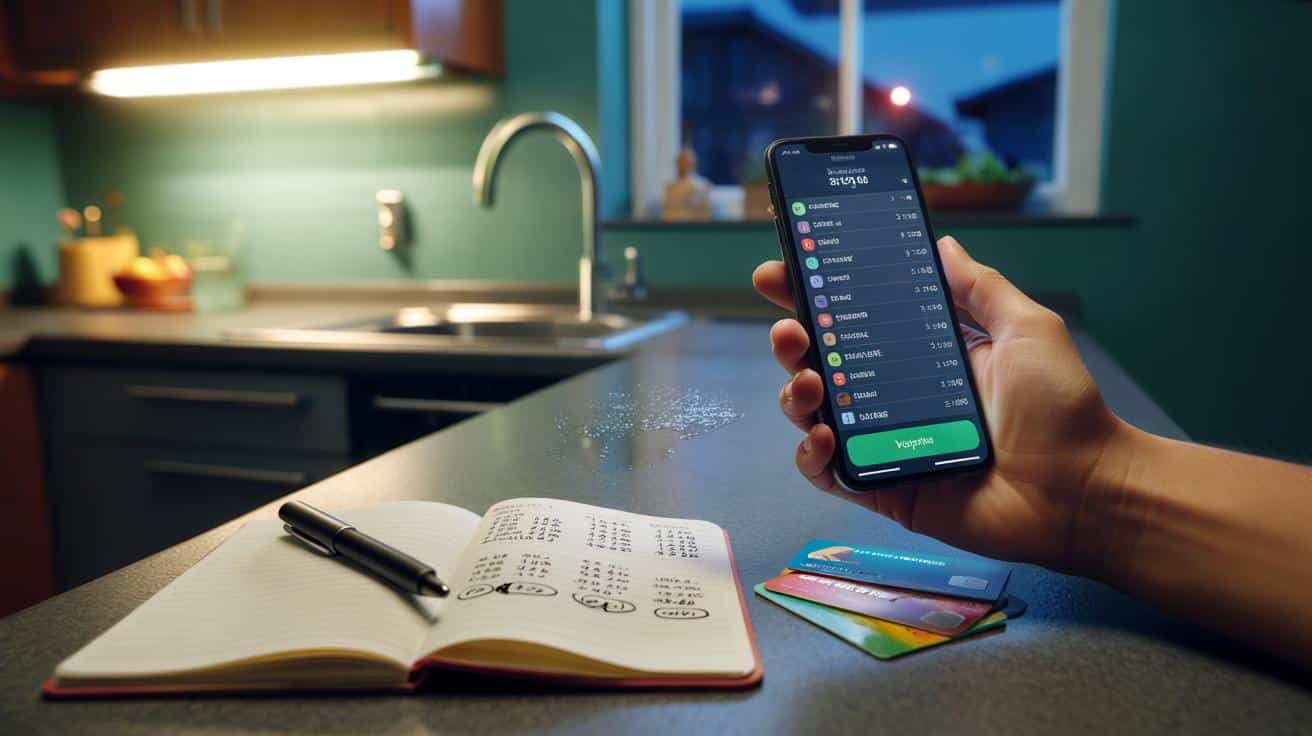
I first noticed the leak on a Tuesday night, staring at my banking app under the fluorescent light of my kitchen. The balance was lower. Again. I zoomed in, scrolling through those little gray lines of transactions that never felt “big” at the time. $4.99 here, $7.50 there, $12.99 hiding under a cute app icon I hadn’t opened in months. Nothing dramatic. Just… constant.
By the third week of that sinking feeling, I pulled out a notebook. Old-school. Pen, paper, no filters. I wrote down every single “small” debit from the last 30 days.
That’s when the number hit me.
I was leaking $65 a week. On nothing I truly remembered choosing.
And once I saw the pattern, I couldn’t unsee it.
The invisible drip that empties your wallet
The strangest part was that my lifestyle hadn’t changed. I wasn’t going out more. I hadn’t bought anything flashy. No new gadgets, no miracle skincare, not even a new hoodie.
Yet my account was behaving like I had quietly moved into a more expensive life. There was this low, constant drain that didn’t match my actual days. Just an invisible drip behind the wall, the financial version of a small water leak you only notice when the paint starts bubbling.
When I added it up over a month, the total was $260.
One streaming service I only used for a show I’d already finished. A “free trial” meditation app that had turned into $9.99 a week. An online tool I’d needed for one project last year, still charging me $19 every month. Plus those casual food delivery fees that had become my lazy Thursday habit.
Nothing individually shocking. That was the trick. Each thing was “only a few dollars.” The kind of amount you shrug off at the register or swipe past in your notifications. But together, those “no big deals” were quietly stealing a full grocery budget from me. Every. Single. Month.
➡️ “I’m over 60 and felt tense in my legs”: the circulation habit that helped
➡️ “This comfort recipe is what I cook when I need something reliable”
➡️ Most people underestimate how routine choices affect their finances
➡️ If your plants stop growing without turning yellow, this internal signal matters
➡️ The right way to clean cutting boards so odors don’t linger
➡️ How irregular routines can disrupt your sense of balance
➡️ This is why your fridge smells come back quickly, and how to stop them
➡️ A simple adjustment to how you start tasks can reduce resistance immediately
Once I circled all those tiny charges, a pattern jumped out. I wasn’t overspending in dramatic ways. I was outsourcing my decisions. Letting “subscribe,” “renew,” and “order again” decide for me.
The apps were designed for that. Default auto-renew. One-click checkouts. Buy now, think later. Tech companies know that if they keep the friction low, we won’t bother cancelling or pausing.
Let’s be honest: nobody really opens their banking app excited to scroll through line items and cancel stuff on a Sunday morning.
So the leak keeps going. Not because we’re reckless. But because the system quietly rewards us for not paying attention.
The simple routine that stopped the $65 leak
The fix started with a single rule: once a week, 10 minutes max, I “date” my money. No spreadsheets. No color-coded budgets. Just me, my banking app, and a calm look at what actually left my account.
I picked Friday night. Not very rock’n’roll, but it stuck. I’d scroll the last seven days, highlight every recurring charge, and ask one plain question: “Would I deliberately choose this again today?”
If the answer wasn’t a clear yes, it went on the chopping block. Subscription cancelled. Auto-renew off. Delivery app deleted for a while. The first week felt brutal. The second week, oddly freeing.
The biggest mistake I’d made before was trying to overhaul everything in one heroic burst of “new me” energy. That kind of sprint rarely survives real life. One bad day at work and you’re back to ordering takeout and ignoring the statements.
So I went for rhythm instead of perfection. A fixed, tiny ritual. Same time, same place, low drama. I also stopped shaming myself for past choices. That $120 annual subscription I’d forgotten about? I treated it like a lesson, not a verdict on my character.
If you’re reading this with a knot in your stomach, you’re not alone. We’ve all been there, that moment when a number on a screen suddenly feels like a mirror.
“I stopped trying to be the person who ‘never wastes money’ and started being the person who checks in once a week,” a friend told me when I shared my leak story. “That tiny shift saved me more than any budgeting app ever did.”
- List every recurring payment for the last 30 days.
- Circle what you haven’t used, or barely remember signing up for.
- Pick one fixed time each week for a 10-minute money check-in.
- Cancel or pause just 1–2 things per week, not everything at once.
- Track the amount you “get back” in a visible place (phone note, fridge, notebook).
*That small list on my fridge, with its scribbled weekly savings, motivated me more than any polished budgeting template ever did.*
What changes when you finally see the pattern
The wild part isn’t just the money you stop losing. It’s the mental space that comes back. Once the $65 leak was patched, I realized how heavy that low-grade financial fog had been. That quiet anxiety while tapping your card, hoping the transaction goes through. That reluctance to open emails from your bank.
After a month of my weekly check-in, my account stopped surprising me. I knew roughly what was coming out and why. The weird “how did I spend that much?” feeling faded. In its place: a calm, almost boring sense of control that felt strangely luxurious.
Over three months, that rescued $65 a week turned into a little over $780. I didn’t treat it like a bonus to blow. I gave it a job. Part went into an emergency stash. Part into something that felt like a real yes: a weekend trip I’d always postponed “because money.”
The number itself matters, sure. But the deeper shift is this: once you train your eye to spot the pattern, you start seeing it everywhere. The half-used memberships. The mindless snacks. The pay-later buttons promising you “flexibility” while charging you quiet fees in the background.
You start asking, gently but firmly, “Do I still choose this?”
Not once. Repeatedly.
| Key point | Detail | Value for the reader |
|---|---|---|
| Spot the leak | Review 30 days of transactions and highlight every small, recurring or forgettable charge | Reveals where money is leaving your account without conscious choice |
| Set a weekly ritual | 10-minute, same-time check-in to review new charges and subscriptions | Creates a sustainable habit that keeps leaks from quietly returning |
| Redirect the savings | Give the recovered $65 a week a purpose: savings, debt, or a meaningful treat | Turns invisible waste into visible progress you can actually feel |
FAQ:
- Question 1How do I start if my transactions feel overwhelming?
- Answer 1Begin with just seven days. Print them or screenshot them, grab a pen, and mark only the small, repeated charges. You don’t need to solve your entire financial life in one sitting, just spot one recurring leak.
- Question 2What if I cancel something and end up needing it later?
- Answer 2You can always re-subscribe. The goal isn’t to ban enjoyment, it’s to reset your choices. Cancelling now doesn’t mean “never again”; it simply means “not by default, only on purpose.”
- Question 3Is there a good amount of subscriptions to have?
- Answer 3There’s no magic number. A better question is: “Do I use this enough that I’d still say yes if it charged me in a single lump sum today?” If the answer is no, it’s probably a leak.
- Question 4What if my leak isn’t subscriptions but daily small purchases?
- Answer 4Try tracking one category for a week: just coffee, or just snacks, or just delivery fees. Put the total on a sticky note where you see it. That quiet visibility often changes your choices faster than strict rules.
- Question 5How long until I feel a difference?
- Answer 5Many people feel lighter after the very first cancellation session, simply because they know what’s going on. Financially, you’ll usually see a clear difference within 2–4 weeks as the next billing cycles hit.