The first time I really noticed it, I was standing in the supermarket queue. My basket was light, but my legs felt like someone had quietly swapped them for concrete pipes. A slow, dull tension climbed from my calves to my thighs, not exactly pain, not exactly numbness, just this heavy squeeze that made me want to sit on the floor between the yogurts and the butter.
The woman at the till chatted about the weather. I nodded, pretending everything was fine, while my hands pressed into my knees for relief. At over 60, you start to wonder if this is “just age” or a warning you shouldn’t ignore.
That evening, I went home, typed “leg tension circulation 60” into the search bar… and stumbled onto a simple habit that quietly changed my days.
When your legs start talking back after 60
There’s a moment, somewhere past 60, when your legs start having a personality of their own. They’re stiff in the morning, swollen around the ankles at night, tight after a short walk to the mailbox. You sit down to rest, and instead of relaxing, your calves buzz and throb like they’re holding a grudge.
You look around in the bus or at the doctor’s waiting room and see the same crossed arms, the same discreet ankle rotations, the same wince when standing up. Nobody says much about it, but you can feel that quiet ballet of discomfort. Circulation, veins, “poor return” as doctors call it. A polite way of saying: your legs are not thrilled.
A friend of mine, Claire, 67, told me the story that finally pushed me to act. She was at her granddaughter’s school show, forced to stand in the back of the gym. After 25 minutes, she felt like her calves were going to crack open. Her ankles had puffed up over her shoes, her thighs were tense, and she caught herself scanning the room for a chair like a thirsty person looks for water.
On the way home, she had to stop twice, not because she was out of breath, but because her legs felt full, like overinflated balloons. At the next appointment, her GP muttered words like “venous insufficiency” and “sedentary habits”. Then came the classic recommendations, the kind we nod at and forget on the way out.
What nobody really tells you clearly is this: once we hit 60, our circulation has less margin for error. Vein walls can lose tone. Valves that help push blood back to the heart become lazier. We sit more, we cross our legs, we stay long hours in front of the TV or the computer, and gravity does the rest. Blood pools in the lower legs, fluids stagnate, and this creates that heaviness, tightness, sometimes even pins-and-needles.
The good news is that **the legs are surprisingly responsive** when we give them a chance. This is not about training for a marathon. It’s about a small, precise change that sends a clear message to the blood: “Up you go, time to move.”
The circulation habit that changed my evenings
The habit that helped me sounds almost too simple: three “circulation breaks” per day. Not a workout. Not a drastic routine. Just three short moments where I stop what I’m doing and actively pump blood with my calves and ankles.
➡️ If your plants stop growing without turning yellow, this internal signal matters
➡️ How irregular routines can disrupt your sense of balance
➡️ “This comfort recipe is what I cook when I need something reliable”
➡️ A simple adjustment to how you start tasks can reduce resistance immediately
➡️ This easy kitchen habit prevents spills before they happen
➡️ This tiny change makes everyday objects easier to live with
➡️ This is why your fridge smells come back quickly, and how to stop them
➡️ Psychology explains what it means if you constantly think about how others might perceive you
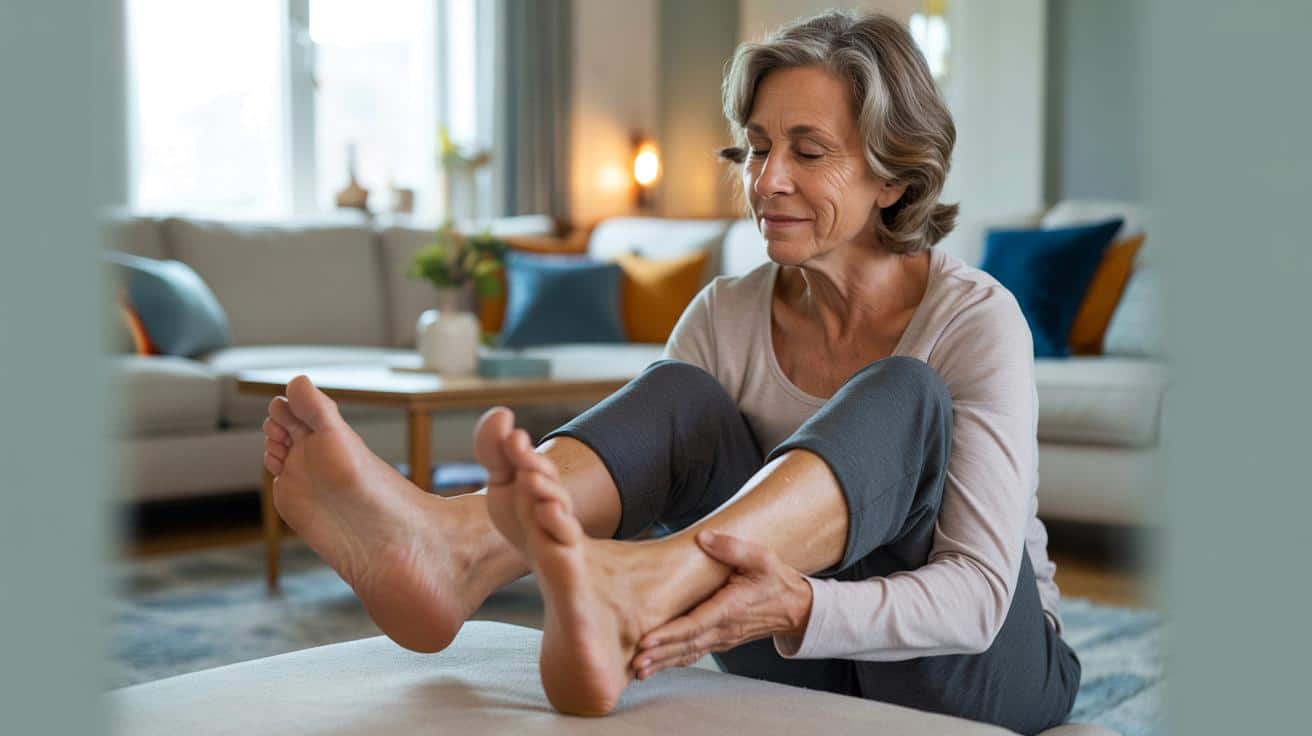
Here’s what it looks like in real life. Morning: before breakfast, I sit at the edge of the bed, stretch out my legs, and slowly flex and point my feet 20 times. Then I draw circles with my ankles, 10 in each direction. Noon: during lunch prep, while the kettle boils, I stand behind the counter and do 15 slow calf raises, going up on my toes, holding for two seconds, then coming back down. Evening: in front of the TV, I place my feet on a low stool and repeat the gentle flex-and-point routine for 2–3 minutes. That’s it.
What surprised me wasn’t instant magic, but the subtle shift after about 10 days. My legs didn’t feel as tight in the supermarket queue. The burning sensation behind the knees after a long drive softened. I could stand during a phone call without looking for the nearest chair after five minutes.
Let’s be honest: nobody really does this every single day, without fail. Some days I forget the noon break, sometimes I do only a few movements. The key is not perfection, it’s repetition. Teaching your veins, day after day, that your calves are going to help them push. Think of the calf as a “second heart” for the legs. Every time you contract it, you squeeze the veins and give the blood a little elevator ride upwards.
Doctors sometimes call this the “calf pump”, but what stuck with me was a sentence from a vascular specialist I met while working on this topic.
“I tell my patients over 60: you don’t need more willpower, you need more small signals to your blood. Every ankle circle is a tiny message that says: don’t stagnate, move.”
To remember those signals, I use a simple box of cues:
- Morning: ankle circles while the coffee brews
- Midday: calf raises while reheating lunch
- Evening: feet up, flex-and-point during the news
This structure anchors the habit into daily life, not into some ideal fitness schedule. That’s probably why it sticks.
Beyond the exercises: a new way of “living with” your legs
Once you start paying attention to your circulation, you notice other little things that add up. The way long hours in a soft armchair leave your legs in a twisted, compressed position. The way crossing your legs all afternoon at the computer leaves a faint imprint on your skin. The way a hot shower at night can feel like a relief, while a very hot bath may increase the feeling of heaviness.
You don’t need to turn your life upside down. You just start creating shortcuts for your blood: walking during phone calls, choosing the stairs for one floor, elevating your feet on a small cushion when reading. *Tiny details, repeated often, become a kind of background therapy.*
There’s another piece people rarely mention: hydration and salt. When we don’t drink much and we love salty snacks, our body tends to retain water, and the legs can become the favorite storage spot. That tension you feel at the end of the day is sometimes a mix of blood circulation and fluid build-up in the tissues.
A simple glass of water in the afternoon, swapping one bag of chips a week for a handful of unsalted nuts, or choosing lighter shoes rather than heavy boots for city walks can nudge the balance. **Small, boring choices can secretly be heroic for your veins.** Nobody applauds you for it, but your ankles notice.
Many people feel guilty when they hear the word “sedentary”. It sounds like a personal failure. Yet, once past 60, it’s less about blame and more about strategy. Work, caring for grandchildren, or just fatigue all tend to chain us to chairs.
“We’ve all been there, that moment when you stand up after an hour on the sofa and your legs feel 20 years older than the rest of you,” an occupational therapist told me. “The idea is not to feel bad about it, but to break that hour into two 30-second circulation moments.”
Here’s a short list of gentle adjustments that many people over 60 find realistic:
- Set a soft alarm every 60–75 minutes during the day and do 10 ankle circles
- When watching TV, stand up during commercials and do 8–10 calf raises
- On public transport, shift weight from one foot to the other instead of locking your knees
- Ask your doctor about compression socks if swelling and varicose veins are already there
- End your shower with cool water on the calves and ankles to “wake up” the veins
They’re small, almost invisible from the outside, but your legs often respond faster than your mind expects.
What your legs might be trying to tell you
The more people I spoke to about this, the more I realized something: tense legs at 60 are not just a physical symptom, they’re also a signal about how we inhabit our own body. Many of us grew up ignoring early warning signs, soldiering on, treating heaviness and swelling as inevitable. Then one day, a doctor says the words “circulation problem”, and suddenly those sensations have a name.
The circulation habit I adopted didn’t just ease the tightness in my calves. It changed how I checked in with myself during the day. Instead of waiting until the discomfort became impossible to ignore, I learned to ask: “How do my legs feel right now?” That question alone is a quiet revolution.
If your legs are talking to you a bit too loudly these days, maybe they’re not accusing you of anything. Maybe they’re asking for movement, for variety, for a different rhythm. Three short breaks per day, a tiny upgrade in how and where you sit, a glass of water when you’d usually grab another coffee — all of that sends a message to your veins that they’re still on your priority list.
Not every story is the same, and serious pain or sudden swelling needs medical attention. Yet in that gray zone of “tight, heavy, uncomfortable legs”, many people find relief in something surprisingly gentle. A few minutes of conscious movement, day after day, can turn a supermarket queue from a place of dread into just what it used to be: a slightly boring, perfectly bearable moment of daily life.
| Key point | Detail | Value for the reader |
|---|---|---|
| Calf and ankle “circulation breaks” | 3 short sessions per day of flexing, pointing, and raising on tiptoes | Simple way to boost blood return without intense exercise |
| Micro-adjustments in daily habits | Short walks, feet elevation, avoiding long static sitting positions | Reduces heaviness and swelling with minimal lifestyle disruption |
| Listening to warning signs | Heaviness, tightness, swelling treated as signals, not fate | Encourages earlier action and better conversations with doctors |
FAQ:
- Is leg tension after 60 always a circulation problem?
Not always. It can be linked to veins, but also to joints, muscles, or nerves. Persistent or one-sided pain, redness, or sudden swelling needs medical evaluation to rule out clots or other issues.- How long does it take for circulation habits to show results?
Many people notice a difference in heaviness and fatigue after 10–15 days of regular calf and ankle exercises. For visible changes in swelling or varicose discomfort, it can take several weeks.- Do I have to exercise intensely to improve my circulation?
No. Gentle, frequent movements are often more effective for venous return than rare, intense efforts. Short walks, calf raises, and ankle circles are already helpful for many over 60.- Are compression stockings really useful?
They can be very helpful when prescribed and properly fitted, especially in cases of venous insufficiency, long trips, or standing jobs. A doctor or pharmacist can guide you on the right level of compression.- When should I worry about my leg symptoms?
Seek urgent medical advice if you notice sudden swelling in one leg, severe pain, warmth, redness, or shortness of breath. For chronic heaviness, night cramps, or visible veins, talk to your GP to check your circulation and get personalized advice.